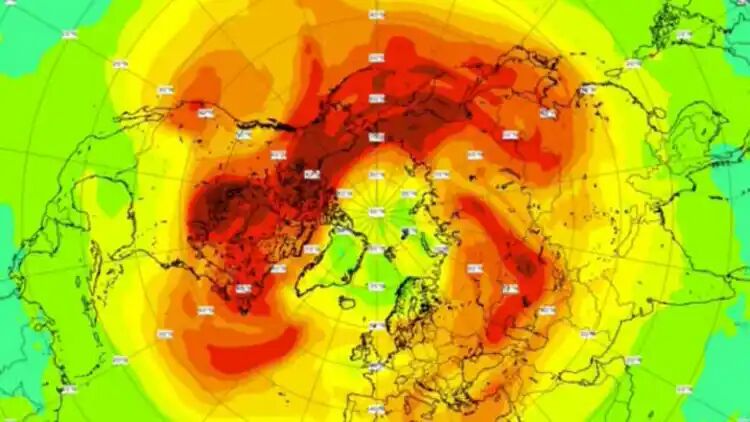
Largest ever ozone hole over the North Pole comes to a close
Hyderabad: An unusually large hole in the ozone layer ever observed over the Arctic in the Northern Hemisphere which formed earlier this year at the break of spring has finally closed after hovering above the North Pole for almost a month, the European Union’s Copernicus Atmosphere Monitoring Service (CAMS) reported.
The European Centre for Medium-Range Weather Forecasts through its Twitter handle – Copernicus ECMWF posted last Thursday that “the unprecedented 2020 northern hemisphere ozone hole has come to an end”.
An article titled ‘Unusual ozone hole opens over the Arctic’, published on the official website of European Space Agency (ESA) earlier this month, said, “In the past weeks, scientists from the German Aerospace Center (DLR) have noticed an unusually strong depletion of ozone over the northern polar regions.” The scientists were able to monitor the form of this Arctic ozone hole by using data collected from the Tropomi instrument onboard the Copernicus Sentinel-5P satellite, it said.
The article also quoted a member of the German Aerospace Center, Diego Loyola, as saying, “The ozone hole we observe over the Arctic this year has a maximum extension of less than 1 million sq km.” Comparing the Arctic ozone hole to the once formed in the Antarctic every year for a duration of around 3 to 4 months and can reach a size of around 20 to 25 million sq km, Loyola said, “This is small compared to the Antarctic hole.”
The scientist further goes on to add that since March 14, the ozone columns have depleted over the Arctic “to what is normally considered ‘ozone hole levels,’ which are less than 220 Dobson Units”. He also said, “We expect the hole to close again during mid-April 2020.” The mission manager of the ESA’s Copernicus Sentinel-5P programme, Claus Zehner, said, that the programme has been continuously monitoring the global ozone measurements from the space since 1995 and over the years they have not witnessed the formation of an ozone hole of this magnitude over the Arctic.
Both Arctic and Antarctic face ozone loss every year, however, the depletion of the ozone layer is significantly less in the North Pole as compared to the South Pole. Extremely cold temperatures (below -80°C), wind fields, sunlight and cloud of chemical substances such as chlorofluorocarbons (CFCs) and other man-made pollutants.
This year unusual atmospheric conditions, including freezing temperatures in the stratosphere created a ‘polar vortex’ – a whirlpool of cold winds has led the ozone levels to plummet causing the massive ozone hole in the north pole. Arctic temperatures do not usually dive as low as in Antarctica. However, this year, powerful winds flowing around the North Pole trapped cold air within creating a ‘polar vortex’ – a whirlpool of cold stratospheric winds.
Last week, the CAMS reported that this unprecedented polar vortex had broken down allowing the ozone-rich air to once again enter the atmospheric region above the North Pole and closing down the unusual ozone hole over the Arctic.
- Roche, Cipla Launch Antibody Cocktail Casirivimab and Imdevimab in India. Check Price, Details
- Woman ‘bought by husband’ for Rs 40,000 tries to sell 5-year-old daughter for Rs 500
- Delhi reported 25 dengue cases till May 22, highest in Jan-May period since 2013
- WILL INDIA BLOCK FACEBOOK, TWITTER, INSTAGRAM IN 2 DAYS AS NEW IT RULES COME INTO EFFECT?
- DELHI POLICE VISITS TWITTER INDIA OFFICES IN DELHI, GURUGRAM AMID ‘CONGRESS TOOLKIT CONTROVERSY’
stay connected with us! For more updates
LIKE SHARE and SUBSCRIBE
if you like the article information then press the like button, Comments you’re opinions about this article and share it with family and friends on social media platforms
SUSCRIBE Quickclarity news to get latest news updates
Disclaimer : This story is auto-aggregated by a computer program and has not been created or edited by Quickclarity news.
Publisher – Telangana Today English
Thank you for reading

 QUICKCLARITY