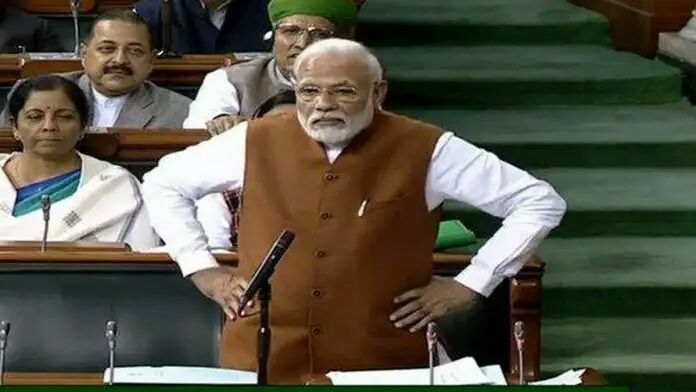
In India’s fight against coronavirus, one arm failed miserably – Parliament
India’s preparedness to deal with the coronavirus pandemic can be judged by many indicators. One of them is the seriousness with which Indian Parliament discussed it. As last as 20 March, the AYUSH Ministry was responding to queries in Parliament and also advocating Ayurveda, Unani, Siddha and Homoeopathy as means ‘to prevent the outbreak of Corona Virus’.
India reported its first positive case of coronavirus on 30 January. The next day saw the beginning of Parliament’s budget session, which lasted until 23 March — a day before Prime Minister Narendra Modi announced the 21-day nationwide lockdown and both the Houses of Parliament were adjourned sine die.
During the session, as many as 50 wide-ranging questions related to coronavirus were asked by members of the two Houses — 27 in Rajya Sabha and 23 in Lok Sabha. Questions pertained to the impact of the virus on India’s economy, jobs, and the manufacturing sector. Some members sought to know about possible cure of the disease.
The answers and clarifications provided by the different ministries of the Modi government can be best described as routine and casual. But the scene was no different outside Parliament. Absurd suggestions and quackery ranging from cow dung to gaumutra (cow urine) to ’15 minutes of sunbathing’ were all suggested as possible cure of coronavirus, most of them by members of the ruling Bharatiya Janata Party (BJP).
Unhealthy stance
On 26 February, Indian government had dispatched 15 tonnes of medical supplies to China, whose Wuhan city had reported the first case of the SARS-CoV-2 virus. This was confirmed by Union health minister Harsh Vardhan in a written reply to a question in the Lok Sabha on 6 March. This was the status of India’s preparedness just 7 days before the World Health Organization (WHO) declared COVID-19 as global pandemic. The number of infected people had crossed 80,000 globally. More importantly, more new cases were being reported from other countries than from China.
India, whose health infrastructure has come under severe scrutiny in the management of the outbreak, had three confirmed cases of coronavirus when it had dispatched the medical supplies to China but saw a rise in positive cases later on a daily basis, along with several deaths. India was sending equipment and medical supplies to China at a time when the disease was spreading globally and China was able to contain it geographically.
On 4 March, civil aviation minister Hardeep Puri informed the Rajya Sabha that ‘Universal screening of all passengers coming in flights from China, Hong Kong, Japan, South Korea, Thailand, Singapore, Nepal, Indonesia, Vietnam, Malaysia, Italy and Iran is being carried out at the airports having international connectivity.’
At that time, coronavirus cases had been reported in as many as 70 countries. The US, which itself had banned visitors from Europe and had already reported more than 150 cases with some deaths, was not seen as fit for inclusion in the list of countries from where flyers were going to be ‘universally screened’.
Govt’s faulty assurances
It appears that the Members of Parliament were pro-active and regularly warning the Modi government of the severity of the situation by asking pertinent questions. The queries from MPs started pouring in during February and the frequency was higher in March. The Modi government kept assuring it was fully prepared to tackle the problem, when it wasn’t.
On 4 March, Prime Minister Modi had announced that he won’t take part in any Holi Milan programme because of the coronavirus threat — which suggests that he was aware of the problem and even knew that physical distancing was one of the measures to stop the spread. His concern was understandable since the virus had infected more than three lakh people globally and the death count had surpassed 14,500 by then. And yet, both Houses of Parliament would continue to function for nearly three weeks more.
If it took so long for the Modi government to realise that a gathering of hundreds of people inside Parliament was also a health hazard, what measure could it have possibly taken for the citizens to avoid community transmission?
Crucial incident
Perhaps it was the incident involving singer Kanika Kapoor that forced the Indian political class to adjourn the House. The news of Kanika Kapoor being infected with COVID-19 broke on 20 March, Friday — and 23 March turned out to be the last day of the budget session. What happened? Lok Sabha MP Dushyant Singh and his mother, former Rajasthan chief minister Vasundhara Raje, had attended a party in Lucknow, where Kanika was also present. Dushyant had later attended Parliament, and so when news about Kanika being infected with Covid-19 broke, it caused an alarm. When the House commenced after two days of recess, the first thing to happen was its adjournment sine die.
If the incident involving Kanika Kapoor had not happened, would the budget session of Parliament have run its full course — until 3 April?
Lack of urgency
On 18 March, the Rajya Sabha had asked for the curtailment or suspension of the budget session but an unwilling government had responded by saying it needed to show resolve to fight the infection’. Minority affairs minister Mukhtar Abbas Naqvi argued that ‘showing any panic will not be in the national interest’.
That same day, the Rajya Sabha also discussed whether MPs should be allowed to wear a face mask or not. Rajya Sabha chairman M. Venkaiah Naidu said that wearing masks is against the rules of the House. Finally, Naidu agreed to allow the members to wear it after the intervention of Congress’ P. Chidambaram and other MPs’ contention that they were simply following government advisory on coronavirus.
This was the status of the affairs of the supreme law making institution when India was preparing for one of the worst human tragedies of recent times.
(This is an unedited and auto-generated story and may not have modified or edited by Quickclarity news)
stay connected with us! For more updates
LIKE SHARE and SUBSCRIBE
if you like the article information then press the like button, Comments you’re opinions about this article and share it with family and friends on social media platforms
SUSCRIBE Quickclarity news to get latest news update
Thank you for reading.

 QUICKCLARITY