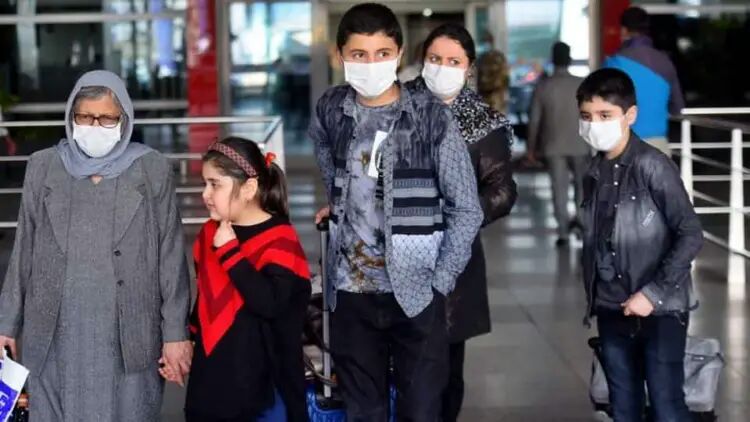
India on Friday announced the suspension of cross-border passenger bus and train services with Bangladesh till April 15 and the closure of 18 immigration checkposts with four neighbouring countries as part of measures to prevent the spread of coronavirus.
Officials said the government is taking more steps to bring back Indians from coronavirus-affected Iran and Italy who have tested negative for the virus, including the operation of at least three flights to these countries over the weekend.
The travel of Indian pilgrims through the Kartarpur Corridor to Gurdwara Darbar Sahib in Pakistan will continue, though the matter is ‘still under consideration’, additional secretary Anil Malik of the home ministry told a news briefing.
Some 300 to 400 people use the corridor on weekdays and the figure doubles on weekends.
Cross-border passenger bus and train services to Bangladesh will be suspended from March 15 to April 15, though freight train services will continue. Border markets along the Bangladeshi frontier in northeastern states will be suspended till further orders, he said.
The government will allow international passenger traffic only through 19 of the 37 land immigration checkposts, and the rest will be closed from midnight on Saturday, Malik said. This measure is aimed at facilitating the better screening of people entering India through checkposts. Among the 18 checkposts being closed is the Wagah-Attari crossing with Pakistan.
The 19 checkposts that will remain open are in Assam, Bihar, Meghalaya, Mizoram, Tripura, Uttar Pradesh, Uttarakhand and West Bengal along the borders with Bangladesh, Bhutan, Nepal and Myanmar. Visa-free entry for Nepalese and Bhutanese citizens will continue, though medical screening at checkposts will be of the same standards as at airports, Malik said.
Checkposts along the frontiers with these four countries are aimed at facilitating cheap and easy travel by residents of border regions and people-to-people contacts.
Additional secretary Dammu Ravi, the external affairs ministry’s pointperson for all COVID-19-related matters, said the government is making ‘strong efforts’ to evacuate Indians from Iran and Italy, with the priority being the return of 220 students from Milan.
So far, India has evacuated 1,031 people from Coronavirus-affected countries, mainly China, and this includes 48 nationals of the Maldives, Myanmar, Bangladesh, China, the US, Madagascar, Sri Lanka, Nepal, South Africa and Peru.
Of them, 819 have been discharged after spending a fortnight in quarantine. Another 236 people evacuated from Japan and China will be discharged from Friday, officials said.
While 58 Indian pilgrims were evacuated from Iran by an Indian Air Force aircraft on March 10, an Iran Air flight ferried 44 people to Mumbai on Friday, and they were quarantined in an Indian Navy facility.
A flight of Iran’s Mahan Air will bring back some Indians to Delhi on Saturday, and Air India is prepared to fly to Tehran to evacuate more Indians. An Air India flight will go to Milan on Saturday afternoon and return the following day with Indian nationals. A team of four doctors reached Rome on Friday to collect samples for the screening of Indians wishing to return, the officials said.
Meanwhile, external affairs minister S Jaishankar told Lok Sabha on Thursday the COVID-19 pandemic is a matter of utmost concern for India as its citizens are spread across the world. ‘At the same time, it is absolutely essential that we react responsibly and soberly,’ he said.
The government has made ‘specific interventions’ where required, including the evacuation of Indians from Wuhan in China, the Diamond Princess crew from Japan or pilgrims from Iran, Jaishankar said.
Referring to the 6,000 Indians in the different provinces of Iran, he said their return will be sequenced while taking into account their location and exposure. The initial focus is on pilgrims, many of whom are in Qom, where the incidence of Coronavirus has been high.
The government is also focusing on Indian students in Iran, many of whom are studying medicine, while the region where most Indian fishermen are located hasn’t been affected severely, Jaishankar said.
stay connected with us! For more updates
LIKE SHARE and SUBSCRIBE
if you like the article information then press the like button, Comments you’re opinions about this article and share it with family and friends on social media platforms
Suscribe Quickclarity News To Get Latest News Update
Thank you for reading.

 QUICKCLARITY