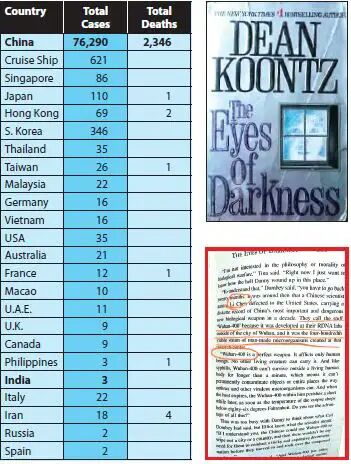
Is Coranavirus a biological Weapon developed by the Chinese called Wuhan-400? This book was published in 1981. Do read the excerpt,’ tweeted Manish Tewari, MP, over the weekend. A few others in other countries too had latched on to the information and had re-tweeted the cover of the book and the underlined passage.
The American thriller writer Dean Kuntz’s The Eyes of Darkness was published in 1981, almost 40 years ago. And the passage that Tewari and others referred to is certainly uncanny. The passage reads:
“They call the stuff ‘Wuhan-400’ because it was developed at their RDNA labs outside of the city of Wuhan, and it was the four hundredth viable strain of man-made micro-organisms created at that centre.”
The book refers to a disease that kills thousands, and claimed it originated from a Chinese military lab in Wuhan.
In the novel by the best-selling suspense author, Chinese scientists engineer a virus as part of its biological weapons program.
Not surprisingly, the tweet went viral, convincing millions of people that Covid-19, as the coronavirus that surfaced in Wuhan is now named, was indeed a biological weapon being developed by the Chinese but which breached security, infected outsiders and turned into an epidemic that went out of control.
A group of scientists from Indian Institute of Technology, New Delhi, unwittingly added to the frenzy by publishing a paper, suggesting that the virus could have been engineered in a laboratory. While the Indian scientists were quick to withdraw the paper, which was posted on an online platform for peer review, the damage had been done, it appeared to confirm the prediction made in the fictional account of Kuntz.
The conspiracy theory was, however, quickly scotched by scientists and the World Health Organisation. There was no evidence whatsoever, declared a statement in the American Associa-tion for the Advancement of Science, “of genetic engineering that we can find. The evidence we have is that the mutations in the virus are completely consistent with natural evolution.”
World Health Organisation’s Director General Dr Tedros chipped in to say that misinformation around the new strain of the virus was causing confusion and spreading fear in the people. Citing the importance of facts, not fear, he declared, “people must have access to accurate information to protect themselves and others”.
A number of false theories have been spread globally about the virus in recent weeks. Russia’s Channel One suggested in its prime-time evening news show Vremya (meaning Time) that US intelligence agencies or pharmaceutical companies were behind it. Another debunked conspiracy theory, published in British and US tabloid media, linked the virus to a video of a Chinese woman eating bat soup.
Another baseless claim that the virus was part of China’s “covert biological weapons programme” cited articles in an American newspaper quoting a former Israeli military intelligence officer. However, no evidence was provided for the claim in and the Israeli source was quoted as saying that “so far there isn’t evidence or indication” to suggest there was a leak.
Another claim inaccurately linked the virus to the suspension of a researcher at Canada’s National Microbiology Laboratory. A Chinese origin researcher, her husband and some of her students from China were removed from the lab following a possible “policy breach”, according to a report by Canada’s national broadcaster CBC last year.
And a now-widely-discredited scientific study released last month linked the new coronavirus to snakes – leading to global headlines discussing the spread of “snake flu”.
But as conspiracy theories swirled, Wuhan, by all accounts a beautiful and vibrant city of 11 million people (Bengaluru, Hyderabad and Ahmedabad, by way of comparison, have populations of less than nine million, seven million and six million people respectively), has turned into a ghost city.
In a bid to ensure that the virus does not spread outside the Hubei province and Wuhan, China has embarked on what is described as the ‘largest quarantine in human history’. Not only Wuhan but several other Chinese cities have now been locked down and an estimated 60 million people are said to be self-quarantined in their homes.
Public transport has been suspended in Wuhan. Military police patrol the streets to ensure people remain indoors at home. Shops, barring those selling essential goods, are shut and so are cafes and cinema halls. Sports centres and exhibition halls have been converted into vast emergency centres to lock up those suspected to have contracted the virus. Gated communities have turned away occupants who returned from a visit outside.
People stepping out to buy essential provisions are being sprayed with disinfectants and their temperature recorded with the help of thermometer guns. The exercise is repeated as they step into stores and clinics. Indeed, the inhabitants in Wuhan have been directed to record their body temperature every day and inform the authorities.
Drones have photographed deserted streets even as reports spoke of some 50,000 pets trapped because their masters are either in hospitals or stranded outside the city. Volunteers are taking permission from owners to break into flats to take care of the animals.
While the city is reported to be struggling with shortages of testing kits, masks and hospital beds, people reporting symptoms of severe pneumonia are being advised to stay back at home. Ambulances, test kits and hospital beds are so scarce that neighbourhood committees of the Chinese Communist Party must recommend people who are to be accorded priority.
Western media have carried first-person accounts of people in Wuhan passing away without treatment; of otherwise healthy people contracting the virus and dying in a matter of days; of an ailing, middle-aged man walking 18 miles to the hospital and back, of people getting medical attention in cars because hospitals are overcrowded.
It is indeed a national emergency and the response has been spectacular. New hospitals have been built almost overnight, with two of them coming up in just 10 days. Hundreds of trucks drive to the city every day with essential and medical supplies so as to prevent shortages. The truck drivers are monitored and screened as they drive in and then drive out of the city.
Yet, the political leadership faces one of the stiffest challenges as people blame it for not taking the people into confidence till it became too late. The Party is being blamed for mishandling the situation, delaying preventive action and forcing the people to post positive messages on social media platforms like Weibo and WeChat, the Chinese equivalent of Twitter and Facebook, and blocking the accounts of those who post critical comments.
While thousands of people have recovered in Wuhan, it will take a long time for normalcy to return. The cost to the Chinese economy-with factories closed, flights cancelled, supply chains broken, exports and shipment stalled-has been enormous but will take months to calculate. But China is known to be resilient and one can trust the Chinese to fight back.
Industrialist Harsh Goenka found himself at the receiving end on Twitter when he somewhat flippantly listed the advantages India would have because of the coronavirus crisis in China.
With the hashtag “Coronavirus positives on Indian economy”, Goenka tweeted that lower international crude prices would reduce cost of production in India, the power sector would gain by cheaper coal prices, inputs for cement plants would get cheaper and Indian export of dyes, chemicals will increase and fetch higher prices as Chinese exports of them slow down.
While many Indians were outraged at Goenka’s insensitivity to the humanitarian crisis in the neighbouring country, the crisis in China is already impacting the Indian economy in various ways. Dealers and shopkeepers selling Chinese goods find their supplies have dried up and they no longer have the products to sell.
Experts were quick to point out that a crisis in one country these days is no reason for other countries to gloat. India Today quoted Mohan Guruswamy as saying, “One economy’s shutdown doesn’t benefit another. When global markets slow down, all of us get hit. China today accounts for one-sixth of the global GDP. Seventy per cent of manufacturing exports are from China. Wait for a few months, there will be a global slump. Pharmaceuticals, rare minerals, etc come from China. Slowdown will start affecting everybody.”
The major sectors which are likely to be affected are automobile sector, pharmaceuticals and technology hardware sector since most of the parts for these products are made in China. Hyundai is said to have shut down three of its South Korean plants due to shortages of a wiring harness that was no longer available from a supplier in China. The Indian manufacturers are also likely to be hit.
The pharmaceutical Industry in India has already flagged its concerns. In a report pharmaceutical-technology.com had this to say, “China is the biggest exporter to India, followed by the US and UAE. In 2018, China exported goods worth $90.4bn to India and accounted for 14.63% of the exports.”
In 2017, telecom instruments, electronics components, computer hardware and peripherals, industrial machinery for dairy, and organic chemicals were the top five items imported by India accounting for 46% of the imports from China and bulk drugs and drug intermediates accounted for $1.5 bn or 3% of India’s imports from China, it pointed out.
According to the Trade Promotion Council of India, approximately 85% of active pharmaceutical ingredients (APIs) imported by Indian companies are from China.
India’s overdependence on China for APIs exposes it to raw material supply disruption and price volatility. Another major hindrance to the Indian pharmaceutical industry is its low capacity utilisation, according to a report from the Ministry of Commerce and Industry (MCI).
India has a capacity utilisation between 30% and 40% as against 75% of China, it admitted. There does seem to be an opportunity lurking for Indian industry and ‘Make in India’ but in a globalised, volatile and uncertain world, countries possibly will have to swim or sink together.
stay connected with us! For more updates
LIKE SHARE and SUBSCRIBE
if you like the article information then press the like button, Comments you’re opinions about this article and share it with family and friends on social media platforms
SUSCRIBE Quickclarity news to get latest news update
Thank you for reading.

 QUICKCLARITY